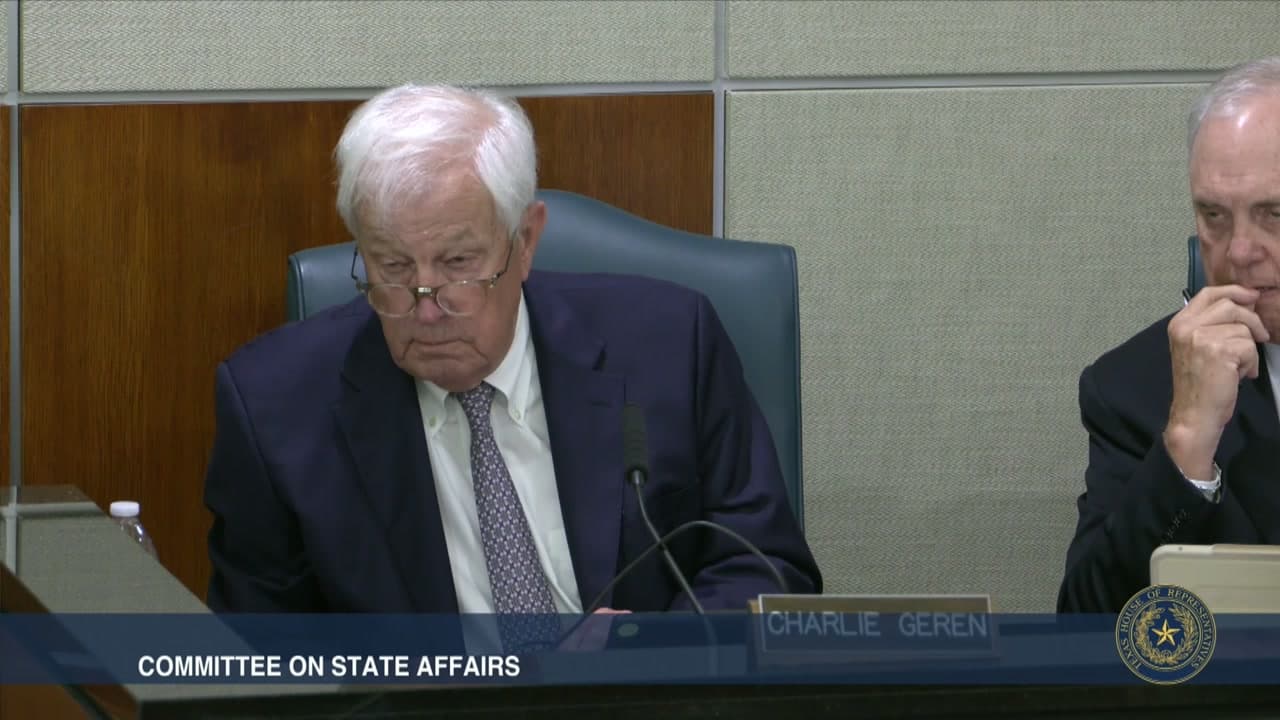
Todd Staples came to House State Affairs on August 19 with a paying load, not a voltage argument. The Texas Oil and Gas Association president put about 6 gigawatts of unmet Permian demand on the table, ready to sign up and pay, and said the reliability plan was contemplated and passed long before data centers became a Texas topic.
"A pause on the clock only stops the solution. It doesn't stop the clock on the problem." Production in the basin is up 430 percent from 2015 to 2025. One unnamed member just committed about $125 million more in temporary power after getting half the megawatts promised. Temp power runs about 2.5 to 3 times grid cost. Pause the permit clock and those costs keep accruing.
PUC Chair Thomas Gleeson opened with the statute members keep mixing up. A Certificate of Convenience and Necessity is the PUC permit a utility needs before it can build a new transmission line. HB 5066 cut that CCN clock from one year to 180 days. It did not require 765 kV. Voltage was a unanimous April 2025 commission decision after ERCOT analysis. The rest of the day was how that clock works when hundreds of landowners show up, and whether Texas pulls a topology that already sits under 58 regional planning projects and 600-plus large-load studies.
Open the Texas map → HyperscaleNews.com/map · Claim a free issue →
Industrial catch-up, then data centers on top
Katie Coleman, for the Texas Association of Manufacturers and the Texas Chemistry Council, told the committee the Gulf Coast pays for these lines too. "This is not about data centers. It's not about renewables. It is about our planning process systematically underplanning for industrial growth for more than ten years." She put remaining import capacity into Houston at about 5 GW, citing ERCOT. Change the approved topology and you redo hundreds of load studies and hundreds of generation interconnection studies.
Will McAdams, a former PUC commissioner appearing as a resource, walked peak load from 85.5 GW in 2023 toward about 121 GW by 2031 on traditional industrial and organic growth alone, roughly 40 percent. Native load about plus 9 GW. Traditional industrial about plus 26 GW. "This factor of data centers is a misnomer. It's a red herring. It is just the cherry on top of the stack of demand that we have been building over the last five years."
ERCOT COO Woody Rickerson said three studies recommended 765 across load scenarios. The case is reliability. He cited more than $200 million a year in congestion savings versus an equivalent 345 build. Pulling 765 would invalidate those 600-plus transmission-company large-load studies already used in Batch Zero assumptions. Oncor pointed members to ERCOT's August 12 letter to Rep. Charlie Geren: far West load-shed risk as early as next summer, generation alone insufficient, topology interdependent.
Gleeson put the Competitive Renewable Energy Zone build next to that warning: planned about $4.9 billion, delivered about $7.9 billion, miles and turn structures driving overruns. The Permian build gets a CREZ-like cost monitor. Right-of-way math cut both ways. A single 345 typically needs about 150 feet; 765 about 200. The same Permian layout at 345 needs two to three times as many lines. Rep. Richard Peña Raymond pressed that comparison from the dais.
Staples said his members did not choose 765. They asked for the most effective system paying customers could sign onto. "We have never supported transmission unless there were customers to pay for it." Coleman said manufacturers were among the biggest skeptics of 765 until they sat through procurement plans. They got comfortable. Changing the approved voltage now restudies the stack those customers are trying to pay for.
Ninety days for parties is the process case
Ben Barkley, public counsel at the Office of Public Utility Counsel, did the arithmetic. Of 180 days, roughly 60 for the administrative law judge and 30 to 35 for the PUC leave about 90 days for parties. One example: a four-day merits hearing with about 230 parties and about five minutes of cross each, then 70 briefs with a four-day reply window. About 600 parties excluded on procedural grounds in one instance. Utilities recover attorney fees through rates. Landowners pay out of pocket and again in rates.
Kristofer Monson, chief administrative law judge at the State Office of Administrative Hearings, stayed on procedure. SOAH is the hearing shop that takes PUC transmission cases when landowners contest a route. The compressed clock blocks the old alignment work that negotiated hundreds of routes down to a short list. Unlike some TCEQ statutes, SOAH has no authority to expand the PUC's 180-day CCN clock. The only pressure valve is a mandamus order telling the agency to decide. Two of five Permian 765 dockets were already done on August 19, too late for new intervenors to join.
Erath County Judge Brandon Huckabee put the notice failure on one labeled link. Segment C8 is a proposed 765-kV route piece in Erath County. Oncor added it after the required public meeting had already happened. Huckabee said a new meeting and direct-mail notice to the newly affected landowners were required and did not happen, and that the administrative law judge's proposal for decision still recommends C8. "If a Texan can have a 765 kV transmission line placed across their property without ever having the opportunity to attend a public meeting where that route was presented, what exactly does due process mean?" Oncor's Jaren Taylor said owners get statutory notice at application filing when links are added after meetings, and that Oncor will not ask a court to force a decision if the PUC needs limited grace past day 180. Minor route modifications can sometimes move a mid-parcel line to a boundary after an order. Paralleling roads and pipelines can block that move.
Joanna Freeble described Import Path 1 notice jumping from about 2,400 at the meeting to about 5,000 at filing. Sidra Hanson put about 280 dismissed for missed filings. Those are notice and unrepresented-party problems for the 90th to draft. They do not reverse ERCOT's reliability case for the voltage.
Chair Ken King said no one had yet been served with eminent domain, and that State Affairs will not move a landowner-blind process next session. Rep. Charlie Geren, who authored the 180-day piece for a Permian plan, agreed to relook at the clock. Rep. Drew Darby pressed double-pay legal fees and the C8 notice gap. Rep. John Smithee asked whether SOAH can pause and send a case back; under the current PUC CCN statute, no.
Equipment is already on order. Rate recovery waits until the plant is in service.
Lower Colorado River Authority's Emily Jolly put about $92 million of equipment spend already on the books. Rate recovery arrives only when the plant is used and useful, in service and serving customers, roughly a 2031 filing after an end-2030 in-service target. She suggested timeline tiers by number of noticed landowners, not voltage alone. AEP Texas President and COO Adrian Rodriguez flagged slot and procurement risk if Texas delays while other grids bid the same long-lead gear.
Walt Baum of Powering Texans cited about 1,500 MW of new gas online since last summer and about 4,000 MW of Texas Energy Fund gas by 2029. Existing gas often runs at 40 to 60 percent capacity. Wires unlock underused East Texas thermal for West Texas gaps. Graham Bacon of Enterprise Products said grid power for Permian processing is often 5 to 8 years out, with on-site temp generation about 3 to 5 times grid cost. That is the same temp-power arithmetic Staples put on oil production.
McAdams warned that delay past session into new law, new rules, ERCOT restudy, and new hearings could mean about three years before forward motion. Earliest Dinosaur-Longshore in-service was framed as 2028. The schedule is the reliability constraint.
Notice and clocks can move. The approved voltage already sits under other studies.
The need case from ERCOT, TXOGA, manufacturers, and a former commissioner is load-serving industrial growth that predates the data-center stack. The process case from OPUC, SOAH, county judges, and landowners is 180-day arithmetic, late-added links, and missed filings. The 90th can rewrite notice, clocks, and rules for landowners without lawyers. Pulling a topology that already anchors 58 regional planning projects and 600-plus large-load studies restudies the stack Staples's members are trying to pay for.
The House public-comment portal for the hearing will close Friday, August 21 at 5pm.
Open the Texas map → HyperscaleNews.com/map · Claim a free issue of Hyperscale News → · Subscribe →
Watch the 765-kV cut: youtube.com/watch?v=_ahTTxLyNPw
Full House video, both charges: house.texas.gov/videos/22746.
Sources
- Texas House Committee on State Affairs, interim hearing, 765-kV transmission charge, August 19, 2026. Per-charge YouTube: https://www.youtube.com/watch?v=_ahTTxLyNPw. Full House video: https://www.house.texas.gov/videos/22746.
- Need case: TXOGA Todd Staples; TAM / Texas Chemistry Council Katie Coleman; McAdams Energy Group Will McAdams; ERCOT COO Woody Rickerson; PUC Chair Thomas Gleeson.
- Process: OPUC Public Counsel Ben Barkley; SOAH Chief ALJ Kristofer Monson; Erath County Judge Brandon Huckabee; Oncor Jaren Taylor.
- Equipment and generation: LCRA Emily Jolly; AEP Texas Adrian Rodriguez; Powering Texans Walt Baum; Enterprise Products Graham Bacon.
- Hearing notice: https://capitol.texas.gov/tlodocs/89R/schedules/html/C4502026081908001.htm.
Dollar, mile, and intervener counts are as spoken on August 19. Treat advocacy cost studies ($80–100B) as claimed, not commission findings.
Not legal advice. Confirm statutes and agency filings against primary sources.