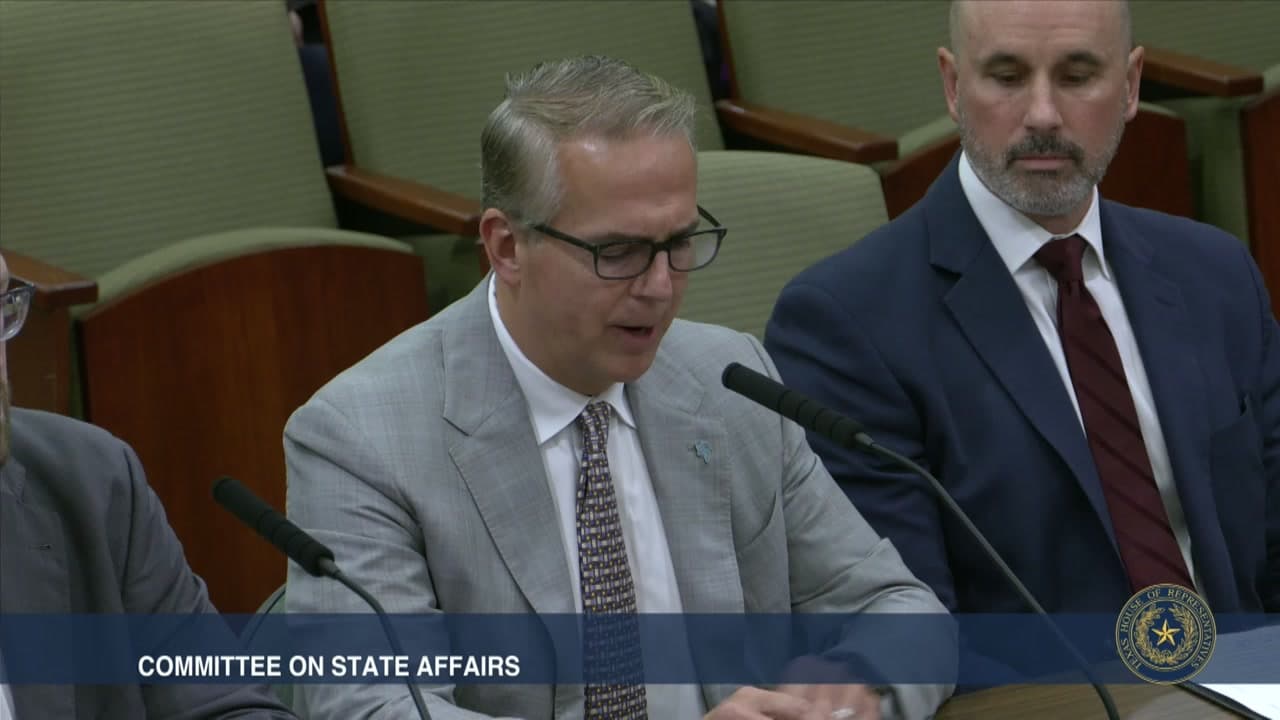
John Knight didn't come to House State Affairs on August 19 to theorize about data centers. Red Oak already has them. Three campuses in Ellis County will add $11 billion in tax base. Another $30 billion sits in the pipeline. Every one of those projects paid the $6.5 million Oncor deposit and finished the studies. They still weren't in Batch Zero.
"Last year we lost $7 billion in projects because we couldn't get them energized," Knight told the committee. "I've heard some people say we're Texas, they're coming here anyways. That's not the case. They can go anywhere. They're agnostic to that."
That is the carrying cost of a queue that still can't punch tickets. ERCOT President and CEO Pablo Vegas put about 205 gigawatts of large load as potentially eligible for Batch Zero, and about 65 GW in the baseload segment with a clearer five-year path. Verification of security, site control, and equipment orders will pull projects. The published totals are maxima. The governor-directed audit pushed launch off September toward year-end, with results communication framed around April.
Open the Texas map → HyperscaleNews.com/map · Claim a free issue →
The doom loop is why Batch Zero exists
Vegas described how each new interconnection request sat on unfinished studies. "We got into this doom loop of having to consistently restudy these projects as more and new projects came in." Batch Zero is the way out: allocate the transmission that exists, lock financial commitments, and plan the wires that still have to be built.
Rep. Rafael Anchía asked the delay questions that matter to anyone holding a site: original launch versus revised launch, when the work finishes, and who drops while they wait. Vegas put launch at the end of the year. Rep. Will Metcalf asked what share of the batch is advanced manufacturing. Vegas put it under 10 percent. The slip lands on the digital load that dominates the queue, and it lands on the manufacturing minority that isn't even in the audit.
Red Oak ISD today receives $42 million from the state fund. Knight said the campuses take that district to $450 million paid in. The land use also caps residential sprawl in the fifteenth-fastest-growing county in the country. None of that shows up if the projects never energize.
Closed-loop is already the record, including from people who didn't come to sell campuses
The water argument that travels on Facebook is a once-through plant drinking a river. That is not what the August 19 record says.
Vegas, answering a question on the governor's letter, said ERCOT has no statutory water authority. He also said the story moved. "Initially I think it was thought that a lot of data centers were using a lot of water, and then it became more widely known that they had moved to a closed-loop system. So they have an initial draw but then don't use as much on an ongoing basis."
Mark Friesenhahn is a fifth-generation Texan, a Comal County pecan farmer, and a professional engineer since 1977. He asked the legislature for life-of-project water-availability certification. He did not come to cheer the industry. He still put the technology on the table: once-through is the old bar; closed-loop or aerial coolers "reduces the water demand by 90 percent, 80 percent, way down." He wants that practice required because agriculture is already losing water. The concession is the engineering, not the politics.
Lancium CEO Michael McNamara said every campus mandates closed-loop. At the Panhandle sites, "the facilities and toilets will use 11,000 gallons a day, but we have at our own expense developed a system using the gypsum-filled water underneath our campus to provide a million gallons a day to the Greenbelt Water Authority." The authority approved the plan the day before the hearing. Pipeline, treatment, and wells are donated for five towns whose reservoir is approaching critically low levels.
Skybox chief development officer Haynes Strater put the firm's largest building at about 600,000 gallons a year. "An office building of about a quarter of the size of that would be about 11.8 million gallons per year." QTS Operations Lead Ryan Kuithe: closed-loop on every build since 2019, "approximately the same amount of water on an annual basis as five single-family homes." At a Briscoe County town hall the Thursday before the hearing, he said 150 residents came in worried about water and left surprised at the operating number. Construction water is non-potable.
Temple McKinnon, water supply planning director at the Texas Water Development Board, still has a data problem. Surveys go out after facilities operate. TWDB sent 2025 surveys to 341 identified data-center sites and had about 29 percent back as of August 19. That is a response-rate problem. It is not a finding that the closed-loop record is fake. Chair Ken King asked who owns aggregate water-use accountability. No single agency claimed it. Rep. Yvonne Davis pressed whether developers will disclose water and power expectations before they pour. Those are 90th-session drafting jobs, not a reason to freeze entitled projects.
Deposits, bills, and the audit as the filter
Kuithe said the quiet part that residential advocates actually need. "We do not believe that residential customers should subsidize our growth or this industry." McNamara put nearly $1.5 billion already committed "in the form of contributions to our local utilities and utility deposits." "The costs that we cause are costs that we must and our customers must pay." No tax abatements on the Lancium record. Turkey gets millions up front for EMS, police, and other infrastructure before the town has to grow into the campus.
PUC Chair Thomas Gleeson said transmission cost allocation is moving from 4 CP to 12 CP. Four coincident peaks is the summer-month snapshot that sets who pays for wires today. Twelve coincident peaks averages all twelve months, with 15-to-30-minute intervals and annual class updates so the large-load share can rise with load growth. Site control, financial security, and long-lead equipment are already interconnection gates. Bankruptcy recovery beyond posted security is still being written.
Benjamin Barkley of the Office of Public Utility Counsel supports 12 CP and the 20-year minimum billing demand charge at 100 percent of requested capacity. He also said the thing that kills the slogan: "The share of the total cost of transmission for residential consumers is going to go down. The total amount of transmission cost is going to go up." Rep. Senfronia Thompson made the same distinction from the dais. Absolute bills can still climb as the statewide transmission cost of service climbs. The design fight is keeping the minimum demand at full requested capacity and adding an exit payment so year-21 socialization and early walk-aways don't strand residentials. Vice Chair Ana Hernandez asked for those tools now, not after the first default.
Strater said the queue is full of people who aren't at the table. "There have been a lot of bad actors in this space that have clogged up our system." He expects the forthcoming audit to be extensive. "It will be clear who is a good actor and who is not." McNamara: "We fully support the governor's audit. We know that these projects must be proven to be a win for ratepayers, for the local communities, and we'll happily open our books to any agency that wants that information." Anchía noted that nobody on the industry panel claimed to be the speculator, and asked for a list. The audit is how you get the list without a statewide pause.
Data Center Coalition's Jess Heck, citing a PwC study of 53 members, put $4.5 billion in Texas state and local tax revenue in 2024, higher than incentives received, plus nearly 429,000 jobs supported and $65.8 billion in GDP contribution. Treat those as industry-filed figures. They still sit on the same table as Knight's ISD arithmetic and McNamara's deposits.
Counties that already live with the campuses asked for neighbors, not a slogan
Chair Ken King put the tax question directly: after construction, can a county count on an elevated tax base for the life of the project? McNamara and Kuithe described server refresh on a five-to-six-year cycle, so business personal property doesn't fall off a cliff after year one. Strater added that pods deploy over time, which smooths the depreciation. King also asked how rural sites get picked and whether operators avoid schools and neighborhoods. That is the siting question local officials actually have.
Childress County Judge Kimberly Jones, who already hosts IREN and Lancium, told the committee the business owners she talks to are for it. Adjacent-landowner complaints get worked. She asked for more local yes-and-no authority, not a statewide freeze. Rick Thompson of the County Judges and Commissioners Association of Texas said the same thing in one line: "Counties are not against data centers. What we're looking for is good neighbors, and what we want to do is have some guardrails and authority." Texas Municipal League's Rick Ramirez echoed it. The package on that panel was mandatory developer-held hearings, buffers from sensitive uses, water studies, and operational standards in unincorporated areas.
Neighbors who don't want the project said so. Susan Tatro learned on August 3 of a 665-acre Mustang / Big Watt site across from her 4-acre place, the third data center within five miles. Myra Alaniz put a 550-acre site 100 feet from a school. Leon County Pct. 3 Commissioner Kyle Workman said rural counties lack tools. Those facts are why Thompson wants notice and buffers. They are not a case for pausing entitled investment.
King asked whether a county can count on the tax base after the construction circus leaves. The operators said yes if the servers refresh and the bills stay paid. Red Oak already ran the experiment. The projects that got power pay. The $7 billion that didn't get power left.
What the delay costs from here
Batch Zero is 205 GW on paper, 65 GW on a clearer path, and late. Every month of verification is a month Knight's next campus can go to another state. Operators who post deposits, run closed-loop, and open the books have a path through the audit. Speculative placeholders don't. The 90th can write county notice and buffer tools, keep the minimum demand charge at full requested capacity, and finish 12 CP without inventing a pause.
Public comments stay open through Friday, August 21 at 5pm: comments.house.texas.gov.
Open the Texas map → HyperscaleNews.com/map · Claim a free issue of Hyperscale News → · Subscribe →
Watch the data-centers cut: youtube.com/watch?v=5BLa1cBKDsM
Full House video, both charges: house.texas.gov/videos/22746.
Sources
- Texas House Committee on State Affairs, interim hearing, data-centers charge, August 19, 2026. Per-charge YouTube: https://www.youtube.com/watch?v=5BLa1cBKDsM. Full House video: https://www.house.texas.gov/videos/22746.
- Grid and cost: PUC Chair Thomas Gleeson; ERCOT President and CEO Pablo Vegas; OPUC Benjamin Barkley.
- Water: TWDB Temple McKinnon; Mark Friesenhahn; Lancium Michael McNamara; Skybox Haynes Strater; QTS Ryan Kuithe.
- Local economics: Red Oak Economic Development John Knight; Childress County Judge Kimberly Jones; CJCAT Rick Thompson; TML Rick Ramirez.
- Hearing notice: https://capitol.texas.gov/tlodocs/89R/schedules/html/C4502026081908001.htm.
Numbers are from the August 19 record. Don't treat Batch Zero published totals as final energization.
Not legal advice. Confirm statutes and agency filings against primary sources.