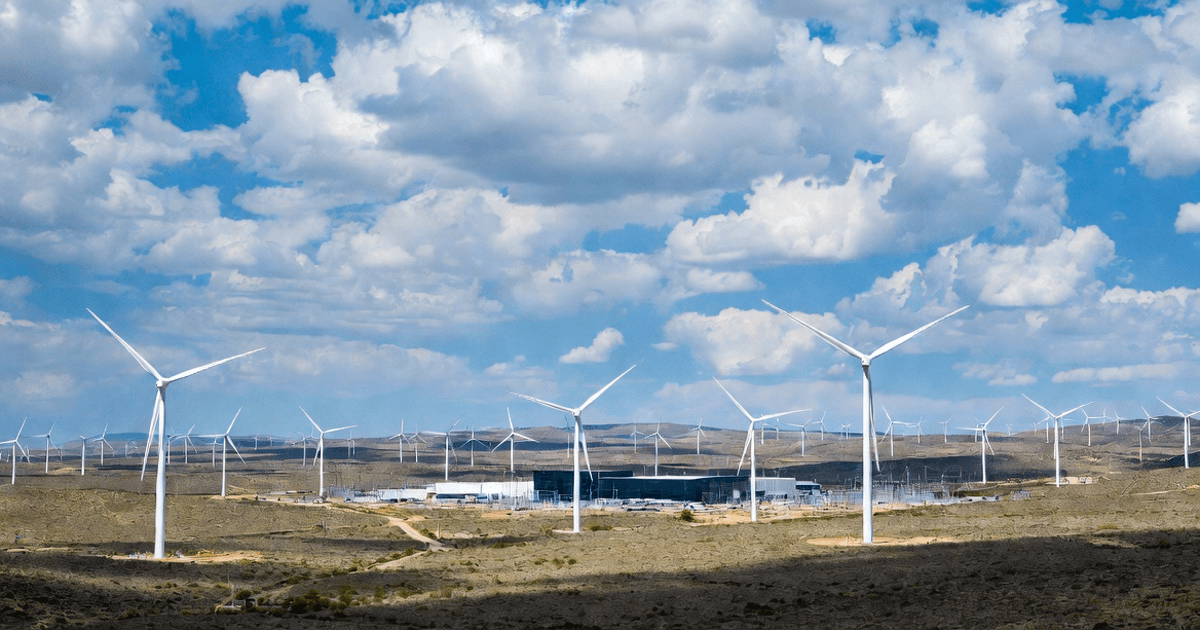
On April 23, 2026, the Public Utility Commission of Texas voted 5-0 to approve PUC Docket 58881, the first net metering arrangement of its kind on the ERCOT grid. The order lets a 265 MW AI data center in Armstrong County share a single ERCOT meter with the existing 265.5 MW Goodnight Wind facility under PURA § 39.169.
The Commission modified the Administrative Law Judge's recommendations on three of the six conditions before signing. The applicant lineup changed once during the case. The order runs 22 pages.
What the PUCT Approved
The order approves a net metering arrangement between three applicants: FGE Goodnight I, LLC (Goodnight Wind), Crusoe Energy Systems LLC, and Ensign Infrastructure LLC. The application was originally filed October 24, 2025 by Crusoe and Goodnight as a two-party joint filing. On March 13, 2026, the applicants filed an amended application that replaced Crusoe with Ensign Infrastructure as the large-load customer of record. Crusoe stayed in the case as a witness and remains bound by the conditions in the Commission's order.
The arrangement is governed by PURA § 39.169, the net metering statute that took effect with SB 6 in 2025. The statute applies when a power generation company that was registered with ERCOT as a stand-alone resource before September 1, 2025 enters a net metering arrangement with a new large-load customer. ERCOT studies the system impacts. The Commission then approves, denies, or imposes reasonable conditions within 60 days of receiving the study. The Commission's authority to impose conditions explicitly includes requiring the load to curtail and the generation to make capacity available during system events.
ERCOT filed its system impact study on March 6, 2026. The study found no transmission security violations, no stranded transmission assets, and a planning reserve margin impact between -0.6% in 2026 and -0.2% in 2030. ERCOT recommended approval with four conditions. The Commission ultimately adopted six.
Where It's Happening
Both facilities sit in Armstrong County, in the Texas Panhandle, near the town of Goodnight on US-287 between Amarillo and Childress.
GOODNIT1, the wind facility, is owned and operated by FGE Goodnight I, LLC. It's a 265.5 MW resource consisting of two intermittent, non-dispatchable wind generation units feeding one ERCOT resource ID. It interconnects to ERCOT at Oncor Electric Delivery Company LLC's Midpoint Switch substation. Greenbelt Electric Cooperative is the distribution service provider for retail delivery to the load. Golden Spread Electric Cooperative is the transmission operator.
Crusoe One, the AI data-center campus, was developed by Crusoe Energy Systems and is built in two phases: Phase 1 at 180 MW and Phase 2 at 85 MW, for 265 MW total. Oncor completed the underlying ERCOT large load interconnection studies before the net metering case was filed. ERCOT approved LLI 1417 (Phase 1, 180 MW) on April 12, 2024, and LLI 2106 (Phase 2, 85 MW) on September 4, 2025. With the load roughly equal to the wind farm's nameplate, almost all of GOODNIT1's output can offset the AI campus's draw inside the meter.
Ensign Infrastructure LLC, a Delaware company registered with the Texas Secretary of State on filing number 806176907, took over as the large-load customer on March 13, 2026. The amended application states Ensign will be assigned both phases of the data-center complex.
How the Net Metering Actually Works
Both facilities sit on the same site behind GOODNIT1's existing point of interconnection. They share one ERCOT-Polled Settlement (EPS) meter and net for settlement under ERCOT Nodal Protocol § 10.3.2.3(2)(a). Separate breakers physically connect the Ensign load to the wind facility, so the load can be disconnected from ERCOT independently of the generator if needed for compliance.
This is the structural feature that distinguishes the arrangement from a normal grid-connected datacenter. The data center is load-netted with the generator at the point of interconnection. ERCOT sees the difference between generation output and load consumption, not the load drawing through the bulk transmission system in the conventional sense.
Oncor remains the transmission service provider for the netted load. Greenbelt remains the distribution service provider with legal authority to provide retail electric delivery service to the netted load. The retail bill flows through Greenbelt, but the physical interconnection topology runs through Oncor's transmission system at Midpoint Switch.
The Six Conditions in the Order
The Commission imposed six conditions on the arrangement. The first three were debated heavily; the last three were largely procedural.
Condition 1: Curtailment within 30 minutes (10 minutes optional), with 60-minute advance notice.
When ERCOT instructs Goodnight's Qualified Scheduling Entity that curtailment of the Ensign load or availability of GOODNIT1's generation capacity is necessary to avoid or mitigate an actual or anticipated transmission emergency or Energy Emergency Alert, two things must happen. Crusoe and Ensign carry the obligation to fully curtail the Ensign load in the manner directed by ERCOT. Goodnight carries the obligation to make GOODNIT1's available generating capacity available for ERCOT's economic dispatch, unless the unit is on outage.
Crusoe and Ensign can shorten the curtailment window from 30 minutes to 10 minutes by providing written confirmation to ERCOT of capability. If the load doesn't fully curtail within the required window, the breakers connecting the Ensign load to GOODNIT1 must be opened and the load disconnected from ERCOT.
When practicable, ERCOT must provide at least 60 minutes of notice in advance of issuing any such instruction. The Commission added this requirement. ERCOT's original recommendation didn't require any advance notice.
Condition 2: Future ERCOT protocols apply.
Crusoe and Ensign must comply with future applicable ERCOT protocols that apply to large loads in net metering arrangements. Goodnight must comply with future protocols that apply to existing generation resources in net metering arrangements. Where future protocols conflict with Condition 1, the protocols control.
The Commission rejected Crusoe and Ensign's argument that Condition 2 "entirely undermines the outcome of this proceeding" by subjecting the approval to future unknown requirements. Commission Staff and ERCOT prevailed on the position that regulatory changes apply to all market participants and there's no basis to insulate these applicants.
Condition 3: No demand response participation by the Ensign load.
Crusoe and Ensign cannot offer the Ensign load into any ERCOT or transmission/distribution service provider demand response product, program, or service, including Ancillary Services, ERCOT's Emergency Response Service, ERCOT-procured capacity contracts, or TDSP load management programs.
The Commission removed Goodnight from this prohibition. Goodnight had argued through briefing that it does not have operational control over the load's commercial decisions. The Commission agreed.
Condition 4: Successor binding via Docket 59616.
The conditions apply to the assets in the proceeding (the Ensign load and GOODNIT1) and bind current owners and their successors. Before transferring either asset to a new entity, the new owner must file an acknowledgment in compliance Docket 59616 that it is bound by the order in place of the prior owner.
Condition 5: Both parties monitor the compliance docket.
Both Goodnight (or the generation owner) and Ensign (or the load owner) must monitor Docket 59616, receive notices via the docket, and maintain up-to-date contact information with the Commission.
Condition 6: Review at 36 to 60 months.
At least 36 months and not more than 60 months after the date of the order, the generation owner and the large-load customer must jointly apply for a Commission determination of whether the conditions should be extended, with or without modification, or rescinded. The Commission added the 36-month floor and 60-month ceiling to mirror the flexibility under recently adopted 16 TAC § 25.205.
What the Commission Changed from the ALJ's Order
Four modifications to the Administrative Law Judge's revised proposed order separate the final order from the recommendation.
- Added the 60-minute advance notice in Condition 1. The ALJ's recommendation imposed the 30-minute curtailment standard without any obligation on ERCOT to give the QSE advance warning. Crusoe and Ensign's initial brief argued that 30 minutes from instruction was a one-size-fits-all standard inconsistent with their operational reality. The Commission split the difference: kept 30 minutes but required ERCOT to give 60 minutes of advance notice when practicable.
- Added ERCOT after-action reporting in Condition 1. This was Commissioner Courtney Hjaltman's contribution, set out in her April 22 memorandum. ERCOT must file a public, non-confidential after-action report in compliance Docket 59616 for any curtailment instruction, explaining the anticipated or actual emergency, why the instruction was appropriate, and any other information ERCOT determines relevant. Hjaltman's reasoning: net metering arrangements introduce operational uncertainty on the grid by virtue of being new, and the Commission needs to evaluate whether Condition 1 is delivering its intended reliability value over time.
- Removed Goodnight from Condition 3. The ALJ's order subjected all three applicants to the demand response prohibition. The Commission found that Goodnight, as the power generation company, doesn't have operational capability to prevent the Ensign load from participating in demand response programs and shouldn't bear that legal responsibility.
- Replaced Condition 6's review trigger. The ALJ's recommendation set a single review point. The Commission substituted a window of 36 to 60 months, mirroring the flexibility codified in 16 TAC § 25.205, the recently adopted Commission rule on net metering arrangements.
The Commission also separated the Condition 1 obligations between the parties to track PURA § 39.169(d)(1) and (2), which distinguishes the retail customer's duty to reduce load from the generation owner's duty to make capacity available. The ALJ's text bundled both duties on all parties; the final order assigns them separately.
What Each Party Argued
Five entities filed substantive briefs: Crusoe Energy Systems and Ensign Infrastructure (jointly), FGE Goodnight I (separately), Greenbelt Electric Cooperative and Golden Spread Electric Cooperative (jointly, as the Co-ops), Commission Staff, and ERCOT.
On Condition 1 (curtailment). Crusoe, Ensign, Goodnight, Greenbelt, and Golden Spread all opposed. Crusoe and Ensign argued the 30-minute window was a one-size-fits-all standard, not tailored to the technical limitations of their equipment, and that "anticipated" transmission emergencies isn't a sufficiently objective trigger. Goodnight argued it has no operational control over Ensign's consumption decisions. The Co-ops argued the curtailment requirement encroaches on Greenbelt's retail jurisdiction and undermines Golden Spread's load-shed planning. Commission Staff and ERCOT supported the standard, citing operational uniformity for grid emergency situations.
On Condition 2 (future protocols). Crusoe and Ensign opposed in its entirety, arguing that subjecting the approval to future unknown requirements "entirely undermines the outcome of this proceeding." Commission Staff and ERCOT prevailed.
On Condition 3 (no demand response). Goodnight, Crusoe, Ensign, and the Co-ops opposed. Crusoe and Ensign argued the prohibition is inequitable and inefficient. The Co-ops argued the prohibition prevents them from running load management programs to serve the load. Commission Staff and ERCOT supported. The Order kept the prohibition for the load but removed the generator's obligation.
On the five-year sunset. Crusoe and Ensign separately proposed that any conditions imposed should automatically expire in five years unless specific facts justified extending them. The Commission rejected the automatic sunset and set the 36-to-60-month review trigger in Condition 6 instead.
The Procedural Timeline
- October 20, 2025: Goodnight submits notice of proposed net metering arrangement to ERCOT.
- October 24, 2025: Crusoe and Goodnight file the joint application.
- November 3, 2025: Goodnight files an amended notice of net metering arrangement.
- March 6, 2026: ERCOT files its system impact study, 120 days after receiving complete information.
- March 13, 2026: The applicants file the amended application replacing Crusoe with Ensign Infrastructure as the large-load customer.
- March 17, 2026: The presiding ALJ issues Order No. 7 finding the application administratively complete.
- March 20, 2026: ALJ issues Order No. 8 granting the parties' request to hear the case on written submission.
- March 31, 2026: Initial briefs filed by Crusoe and Ensign, FGE Goodnight, the Co-ops, ERCOT, and Commission Staff.
- April 7, 2026: Reply briefs and proposed orders filed.
- April 10, 2026: Proposed Order with Memorandum issued by PUC OPDM.
- April 14, 2026: Revised Proposed Order Memorandum issued. Crusoe and Ensign and FGE Goodnight file exceptions.
- April 17, 2026: Open meeting, oral argument heard. Each party allotted 10 minutes, with joint allocations for aligned parties.
- April 22, 2026: Memoranda filed by Chairman Gleeson and Commissioner Hjaltman previewing modifications.
- April 23, 2026: Commission votes 5-0. Order signed.
What This Means for the Next Wave
PUC Docket 58881 is the first net metering case decided on the ERCOT grid under PURA § 39.169. Three pieces of the framework are now Commission-validated and will inform every application that follows.
- The 30-minute curtailment standard with 60-minute advance notice and after-action reporting. Future applicants will start from this baseline. The 10-minute optional window gives applicants who can engineer faster curtailment a way to demonstrate operational sophistication.
- Demand response prohibition limited to the load, not the generator. Generation owners do not carry legal responsibility for compliance functions they don't operationally control.
- The 36-to-60-month review trigger. Conditions don't automatically expire, and they don't run indefinitely without scheduled review either.
The 58881 order is already being used as the template. On April 24, 2026, one day after the Commission signed, the Administrative Law Judge in Docket 58872 (Freestone Power Generation, LLC and C1 Freestone 1 LLC) filed a Proposed Order that, on page 6, states the conditions are "derived primarily from Commission Staff's reply brief and proposed order, ERCOT's reply brief and proposed ordering paragraphs, and the Commission's Order in Docket No. 58881."
Docket 58872 is structurally different. The Freestone Energy Center is a 1,099 MW gas-fired combined-cycle generator in Freestone County. The C1 Load is a 760 MW AI data-center complex, roughly four times the size of Crusoe One. Oncor is the TSP between the generator and the ERCOT grid, and Brazos Electric Power Cooperative is a second TSP owning the connecting transmission facilities between the generator and the load. Navarro County Electric Cooperative is the DSP for retail service.
PURA § 39.169(d) adds a mandatory condition on dispatchable generators that didn't apply in 58881. Because FREC is dispatchable gas that has historically supplied ERCOT, the Commission "must" impose a condition requiring the generator to make at least that amount of dispatchable capacity available to ERCOT after the arrangement, at ERCOT's direction, in advance of an anticipated emergency. GOODNIT1 is non-dispatchable wind and didn't carry that statutory floor.
The 58872 proposed order does not yet incorporate the three modifications the Commission made in 58881: 60-minute advance notice in Condition 1, ERCOT after-action reporting, and removing the generator from the Condition 3 demand response prohibition. Whether those carry across to gas-plant cases is the open question.
Comments and exceptions on the 58872 proposed order are due May 1, 2026. The Commission has not yet set an open meeting date for the vote.
For developers, the structural takeaway from 58881 is the timeline. GOODNIT1 was already operating, already interconnected at Midpoint Switch, and already registered with ERCOT before the September 1, 2025 cutoff. Oncor's large load interconnection studies for the Crusoe One load were already approved. That sequence gave the project a path to energization that a brand-new build with a new ERCOT queue position cannot match. For developers sitting on existing wind, solar, or gas resources with available headroom, this case is the precedent.
For ratepayers and rural cooperatives, the substantive concession is in Ordering Paragraph 2: net metering loads under these conditions are removed from the relevant transmission operators' load-shed obligations. Greenbelt and Golden Spread argued the curtailment regime would otherwise leave them holding the bag for a behind-the-meter customer they don't bill. The Commission's carve-out is the answer.
How to Read the Filings Yourself
Every document referenced in this article is publicly available on the PUC Interchange. The control number is 58881. Six items are most worth pulling.
- Item 105 (April 23, 2026): The signed Final Order.
- Item 92 (April 10, 2026): The Proposed Order with Memorandum.
- Item 103 (April 22, 2026): The joint Gleeson and Hjaltman memorandum previewing the Commission's modifications.
- Item 96 (April 14, 2026): FGE Goodnight I's Exceptions to the Proposed Order.
- Item 2 (October 24, 2025): The original Joint Application by Crusoe and Goodnight.
- ERCOT's System Impact Study (March 6, 2026): Filed at Item 41.
The compliance docket for ongoing filings is Docket 59616.
"PURA § 39.169 was the Texas legislature's deliberate response to the ERCOT queue backlog facing data center developers in the state, and Docket 58881 is the first case to test it," said James Dickey, CEO of JD Key Government Affairs, sponsor of Hyperscale News. "The conditions the Commission imposed will set the baseline for every net metering application that follows. Developers sitting on existing generation assets in ERCOT now have a Commission-validated template. The caveat is operational: ERCOT gets 60 minutes of notice, and the load has 30 minutes to come off when the grid calls. Operations have to be engineered to that standard, not retrofitted to it."
What to Watch Next
Three items on the near-term docket. Comments and exceptions on the Docket 58872 proposed order are due May 1, 2026, and the Commission's vote at the next available open meeting will show whether the 58881 modifications (60-minute advance notice, after-action reporting, generator removed from the demand response prohibition) carry across to gas-plant net metering. ERCOT's first after-action report under Condition 1 of Docket 58881 will be the first publicly filed evidence of how the curtailment regime performs. The 36-month review window in Docket 58881 opens in April 2029.
GOODNIT1 was the first existing wind farm in Texas to share its meter with an AI data center. It won't be the last. The conditions in this Order are the template for what comes next.